
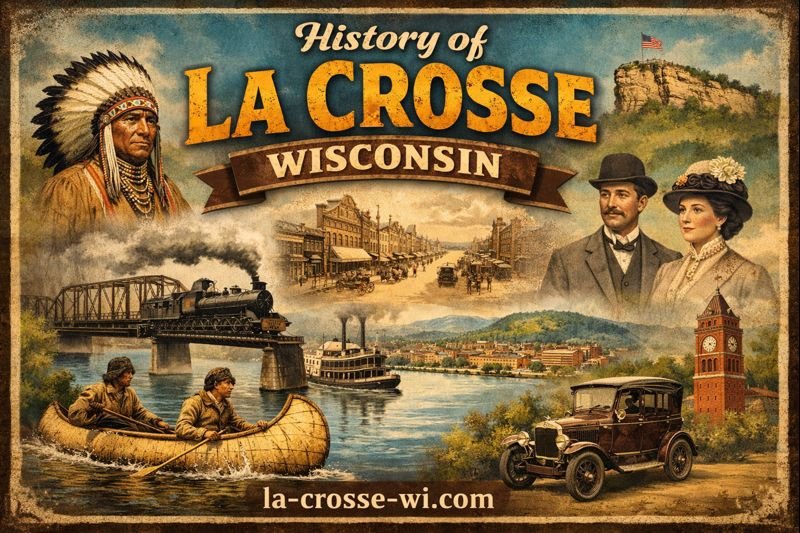
History of La Crosse, Wisconsin
Where Rivers Converge and History Flows
The Name Behind the City
The name “La Crosse” is of pure French origin, derived from an observation made by early French explorers and traders as they ascended the Mississippi River. Upon reaching the broad prairie that stretched two miles eastward from the bluffs, they witnessed Indigenous peoples playing a ball game using long-handled racquets. The sport reminded the French of their tennis game, which they called “la crosse”—a name originating from the fact that the racquet resembled a bishop’s crozier.
The area was originally known as “Prairie La Crosse,” and the river flowing through was called “Ball River” by early settlers, referencing the games that took place on these prairies for centuries.
Indigenous Heritage
The Ho-Chunk people are the Indigenous inhabitants of Wisconsin, and their influence on La Crosse County is tied to their continuous presence in the region. The Ho-Chunk, along with the Ojibwe and Sioux, frequented the La Crosse area for more than 1,000 years before European settlement. Prior to colonization, they were primarily hunters, farmers, and fishermen. Despite forced relocation by the U.S. Government in the 19th century, many families journeyed back to their homeland. Today, the Ho-Chunk Nation remains a sovereign nation, with their people continuing to enrich the area’s cultural heritage.
European Settlement & Early Growth
On November 8, 1841, nineteen-year-old Nathan Myrick from New York arrived at Prairie La Crosse, marking the beginning of permanent European settlement. Originally traveling to Prairie du Chien to work in the fur trade, Myrick found the market already saturated with established traders. He decided instead to establish a trading post upriver at the unsettled site of Prairie La Crosse.
Myrick was warmly greeted by the Ho-Chunk people and built a log cabin from which he launched his fur trading business. He first constructed a temporary trading post on Barron Island (now Pettibone Park), relocating to the mainland prairie the following year. The location proved ideal—situated near the junction of the Black, La Crosse, and Mississippi Rivers on a broad plain perfect for development.
Nathan Myrick establishes the first trading post, beginning permanent European settlement
First post office established in the growing settlement
First general store opens; John and Fredericka Levy arrive as early settlers
When Myrick departed, La Crosse was a village of just 20 settlers
La Crosse County formed from Crawford County; designated as county seat
Population reaches 543; unofficial census taken by Rev. Carr
Village officially incorporated as a city on March 14
Railroad reaches La Crosse from the east, transforming the city into a busy river port where steam train met steamboat
Population grows to over 25,000 as steamboat traffic and sawmills drive prosperity
Massive Victorian city hall constructed, 50 years after incorporation
The Lumber Boom
Logging the extensive white pine forests of Wisconsin fueled La Crosse’s first major industry, building fortunes and employing over 4,000 people. Some 20 million acres of Wisconsin forests had been ceded to the U.S. through Native American land cessions, providing seemingly endless resources for the industry.
The first successful logging on the Black River began in 1839. Felled trees were cut into 16-foot lengths and pulled by oxen or horses through snow to frozen rivers. In spring, logs floated downstream to the 33 sawmills operating in the area. Cadwallader Washburn, one of La Crosse’s prominent lumber entrepreneurs, improved the Black River in 1865, making it much easier to float logs to the awaiting sawmills.
Many sawmills were constructed along the shoreline from Onalaska south to Isle la Plume on La Crosse’s south side. The forests of the Black River were depleted in 60 years, and the lumber era ended shortly after 1900. Many New Englanders who became wealthy from the pine trade moved further west or south to continue their lumbering enterprises.
🪵 Lumber Industry
33 sawmills operated at peak; 4,000+ workers employed
🍺 Brewing Heritage
8 breweries operating simultaneously by 1900
🚂 Transportation Hub
Gateway to the West where railroad met steamboat
🎓 Education Center
Three colleges established between 1890-1912
Brewing Tradition
The La Crosse brewing industry stood proudly among giants like Milwaukee during the late 19th and 20th centuries. European immigrants thrived in the local brewing trade, with the first breweries appearing in the 1850s. From 1868 to 1920, there were always at least four breweries running in the city, including notable names like Zeisler and Heileman.
Prohibition devastated many La Crosse breweries, though some survived by producing malt and soda products during the lean years. The G. Heileman Brewery emerged as one of two survivors by the 1950s—down from eight operating simultaneously in 1900. Today, the brewing tradition continues as City Brewery, owned by a group of workers, carrying on this proud heritage.
The Inventor’s Velocity
Web Development & Digital Marketing That Moves at the Speed of Innovation
Looking to establish your business’s online presence in La Crosse or beyond? We specialize in WordPress websites, local SEO, and digital marketing strategies that help businesses thrive.
Notable Figures
Nathan Myrick (1822-1903)
Founder of La Crosse who arrived at age 19 to establish a trading post, laying the foundation for the city’s development.
Ellen & Gideon Hixon
Prominent lumber family who became wealthy through the industry. Ellen supported hospitals, orphanages, schools, and led the effort to preserve Grandad Bluff.
Dr. Adolf Gundersen
Arrived in 1891 and founded the first Gundersen Clinic, practicing with his six sons and establishing a healthcare legacy that continues today.
Chief One-Eyed Decorah (ca. 1782-1864)
Respected Ho-Chunk leader who called La Crosse home during the critical period of European settlement.
George W. Peck (1840-1916)
Wisconsin Governor who hailed from La Crosse, also famous as an author and journalist.
Patrick Lucey (1918-2014)
Wisconsin Governor from La Crosse who served from 1971-1977 and later as U.S. Ambassador to Mexico.
Grandad Bluff: A Treasured Landmark
Rising 600 feet above the city, Grandad Bluff offers panoramic views of the Mississippi River Valley spanning three states—Wisconsin, Minnesota, and Iowa. Wisconsin Trails readers have voted it “the most scenic view in the state.”
The land was first purchased from the state by Judge George Gale in July 1851. Between 1851 and 1912, there were 83 transfers of the property, with the bluff’s limestone quarried for construction materials. When plans emerged to sell the bluff for large-scale quarrying, La Crosse residents were outraged.
Ellen Hixon led the effort to save Grandad Bluff, personally financing much of the $15,000 required for land acquisition in 1909. In 1912, the Hixon family donated the land to the city as a park, ensuring its preservation forever. A shelter house was constructed in 1938 by the Works Progress Administration, and in 2015, a bronze statue of Ellen Hixon was dedicated atop the bluff she worked so hard to save.
La Crosse Fun Facts
- La Crosse is located in the Driftless Region—a unique landscape untouched by Holocene glaciation
- The city sits at the confluence of three rivers: the Mississippi, Black, and La Crosse
- Home to the “World’s Largest Six Pack”—storage tanks at City Brewery holding enough beer for one person’s six-pack daily for 3,351 years
- The Skyrockers organization has conducted New Year’s Eve fireworks from Grandad Bluff since 1929
- La Crosse is home to nearly 20,000 students across three institutions: UW-La Crosse (1909), Viterbo University (1890), and Western Technical College (1911)
- In 2016, Mayor Tim Kabat issued a proclamation apologizing for La Crosse’s history as a sundown town
- The city’s metro area produces a GDP of $10.1 billion as of 2023
La Crosse Today
Today, La Crosse remains the largest city on Wisconsin’s western border, serving as a regional hub for education, healthcare, manufacturing, and transportation. The city is headquarters or regional home to major employers including Kwik Trip, Organic Valley, Mayo Clinic, Gundersen Health System, La Crosse Technology, City Brewing Company, and Trane.
Connected to the world through the La Crosse Regional Airport, Amtrak’s Borealis service to Chicago and Minneapolis, and Interstate 90, the city continues to thrive while honoring its rich heritage. The Port of La Crosse still welcomes riverboats, connecting modern visitors to the waterways that first made this location so valuable.
From a young fur trader’s cabin in 1841 to a thriving modern city, La Crosse stands as a testament to the spirit of those who built their dreams where the rivers converge.